


Garden Route · Coastal HVAC Care
Preventing Aircon Rust from Salt Air Corrosion on the Garden Route
Salt air is the single biggest cause of premature airconditioning failure on the Garden Route coast. Knysna, Plettenberg Bay, Mossel Bay, and George all sit in environments where ocean-borne salt deposits on outdoor condenser units year-round. This page explains what happens, how fast it happens, and what can be done about it.
What Salt Air Actually Does to an Airconditioning Unit
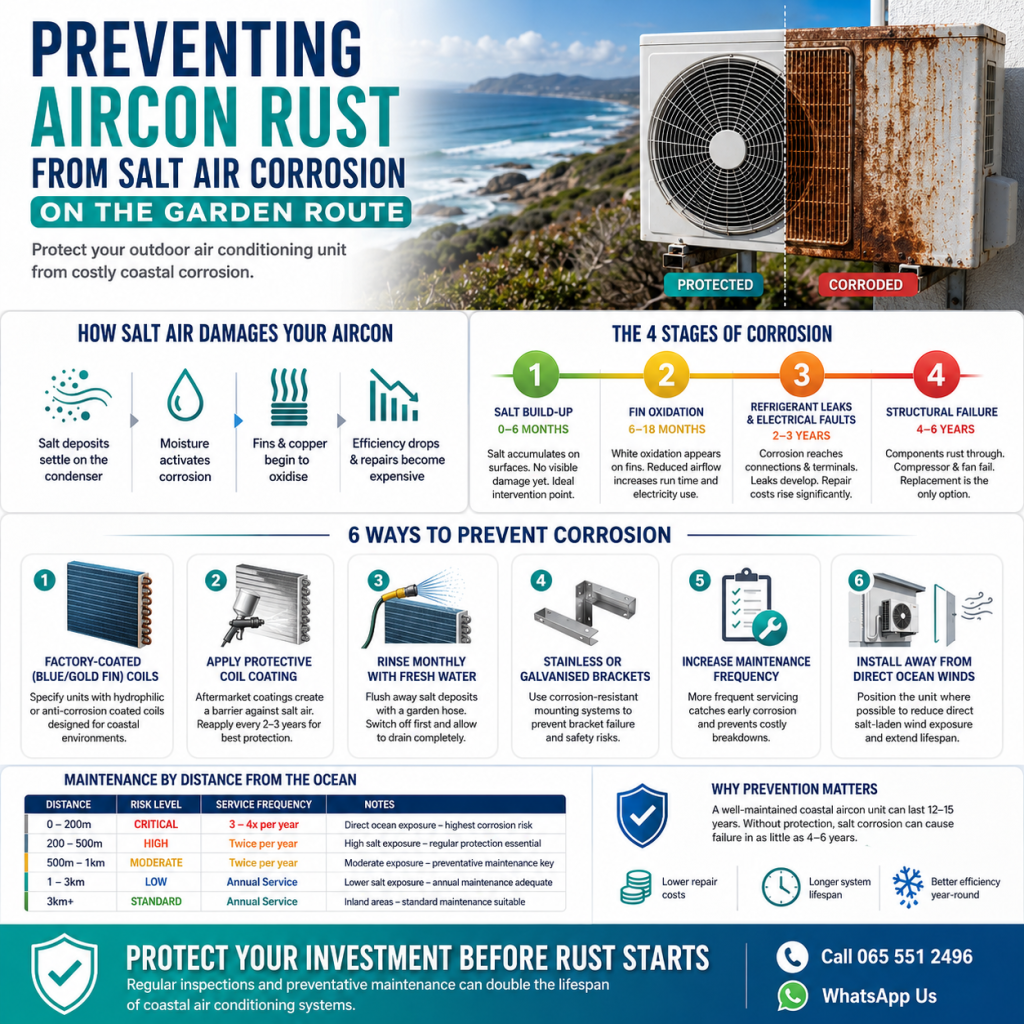
Salt air corrosion is not a gradual cosmetic problem — it is a progressive structural failure that accelerates the longer it is left unaddressed. Ocean air along the Garden Route carries sodium chloride particles that deposit on every exposed metal surface of an outdoor condenser unit. Once moisture activates those deposits, electrochemical corrosion begins. The process is invisible in the early stages but moves quickly on aluminium fins, copper tubing, and mild steel components.
The damage sequence follows a predictable pattern regardless of brand. Condenser fins corrode and collapse, reducing airflow through the coil. Refrigerant line connections develop pinhole leaks at corroded joints. Electrical terminals oxidise, creating resistance that causes contactors and capacitors to work harder and fail earlier. Fan motor housings rust through, allowing moisture ingress into windings. A unit that would run for 12 to 15 years in an inland environment can fail within 4 to 6 years on a sea-facing site with no corrosion prevention in place.
The Four Stages of Salt Corrosion Damage
Stage 1 — Months 1 to 6
Surface Salt Deposit
Salt particles accumulate on condenser fins and housing surfaces. No visible damage yet. Unit performance is unaffected. This is the ideal intervention point — fins can be cleaned and coated before any oxidation begins.
Stage 2 — Months 6 to 18
Fin Oxidation Begins
White oxidation appears on aluminium fins. Fins begin to lose structural integrity and collapse under their own weight. Airflow restriction causes the unit to run longer cycles to reach setpoint. Electricity consumption increases noticeably.
Stage 3 — Year 2 to 3
Refrigerant Leaks & Electrical Faults
Corrosion reaches copper connections and electrical terminals. Refrigerant leaks develop at corroded flare joints. Contactors and capacitors begin failing from oxidised terminals. Repair costs at this stage frequently exceed 40% of replacement value.
Stage 4 — Year 4 to 6
Structural Failure
Fan motor housing rusts through. Compressor fails from sustained overload. The unit reaches end of economical repair life well before the warranty period of an equivalent inland installation. Replacement is the only option.
Six Ways to Prevent Salt Air Corrosion on Your Aircon
None of these measures are expensive relative to the cost of early unit replacement. The most effective approach combines the right equipment specification at installation with a maintenance schedule suited to the coastal exposure level of the specific site.
Specify a Unit with a Factory Hydrophilic or Anti-Corrosion Coated Coil
Several manufacturers offer models with factory-applied fin coatings specifically designed for coastal environments. These coatings — sometimes called Blue Fin, Hydrophilic Aluminium, or Gold Fin treatments — significantly slow the oxidation process on the condenser coil. Specifying the right model at installation is the single highest-leverage decision for a sea-facing property. This is a specification choice that cannot be retrofitted after the unit is installed.
Apply an Aftermarket Condenser Coil Coating
For existing units, a professionally applied coil coating provides a barrier between the aluminium fins and the salt-laden air. Products such as Nu-Calgon Coilcoat and equivalent clear-coat treatments are applied to the cleaned condenser coil during a service visit. The coating does not eliminate corrosion indefinitely, but it substantially extends the time before fin oxidation becomes structurally significant. Reapplication every two to three years is recommended for sites within 500 metres of the ocean.
Rinse the Condenser Unit Regularly with Fresh Water
Salt deposits activate when they are repeatedly wetted and dried by dew and humidity cycles. A monthly rinse of the outdoor condenser unit with a garden hose — not a pressure washer, which bends the fins — removes accumulated salt before it has time to begin the oxidation cycle. This is the lowest-cost preventive measure available and is appropriate for any property within 2 kilometres of the ocean. Switch the unit off before rinsing and allow it to drain fully before restarting.
Use a Corrosion-Resistant Bracket and Mounting System
Standard mild steel brackets rust rapidly in coastal environments. Hot-dipped galvanised or stainless steel brackets are required on sea-facing sites. The bracket is what holds the outdoor unit to the wall or roof structure — if it corrodes through, the unit becomes a safety risk regardless of its own condition. See our dedicated page on aircon brackets for coastal rust prevention for full detail on bracket specifications.
Increase Service Frequency for Coastal Sites
A standard once-a-year maintenance schedule is inadequate for any property within direct salt air exposure range. Twice-yearly servicing for properties within 1 kilometre of the ocean, and three times yearly for units on sea-facing walls or balconies, gives the technician the opportunity to catch early corrosion before it becomes structural damage. Each visit includes a coil inspection, electrical terminal check, and assessment of the bracket and pipe run condition.
Position the Outdoor Unit to Minimise Direct Ocean Wind Exposure
Where the building layout allows it, positioning the outdoor condenser unit on a wall sheltered from the prevailing ocean breeze dramatically reduces salt particle impingement. A unit on the leeward side of a building can receive a fraction of the salt load of one facing the ocean directly. This is a factor Swiftfix considers during every installation site assessment on the Garden Route coast.
Distance from the Ocean: How It Affects Your Maintenance Schedule
Salt concentration in the air drops significantly with distance from the shoreline, but it does not reach negligible levels for several kilometres. The table below gives practical guidance for Garden Route coastal properties.
| Distance from Ocean | Risk Level | Recommended Service Frequency | Coil Coating |
|---|---|---|---|
| 0 to 200m | Critical | 3 to 4 times per year | Mandatory — factory coated unit required |
| 200m to 500m | High | Twice per year | Strongly recommended |
| 500m to 1km | Moderate | Twice per year | Recommended |
| 1km to 3km | Low to Moderate | Once per year minimum | Optional but beneficial |
| Beyond 3km | Standard | Once per year | Not required |
Note: Lagoon-facing properties in Knysna can experience salt air exposure comparable to ocean-facing sites at similar distances due to tidal wind patterns across the water surface. Properties on elevated sites exposed to prevailing south-westerly winds should also be treated as one risk category higher than the distance alone would suggest.
Common Questions About Salt Air and Aircon Corrosion
Can a corroded condenser coil be repaired or does it need replacing?
Early-stage fin corrosion can be treated with a coil coating once the fins are cleaned. Once the fins have collapsed to the point of significantly restricting airflow, or once the coil itself has developed pinhole leaks, replacement of the coil or the entire outdoor unit is required. Coil replacement is possible on some units but can approach the cost of a new unit on compact split systems. Swiftfix will assess and advise honestly on the repair-versus-replace decision.
Does the warranty cover salt air corrosion damage?
No. Manufacturer warranties universally exclude corrosion damage caused by environmental exposure, including salt air. This exclusion applies whether or not the unit was specified as coastal-rated. The warranty covers manufacturing defects, not environmental degradation. This is why prevention through correct specification and maintenance is the only protection available.
My unit is only two years old and already showing rust. Is this normal for Knysna?
Surface rust on the outer casing within two years is very common on sea-facing sites in Knysna and Plettenberg Bay, particularly on the base pan and bracket contact points. This is cosmetic and not immediately dangerous. What matters is the condition of the condenser fins and copper connections. If those are also showing oxidation at two years, the unit was either not specified with a coastal-rated coil or has had no preventive maintenance. A service visit at this point to apply a coil coating can still extend the unit’s life significantly.
How do I know if my current unit has a coastal-rated coil?
Check the model number against the manufacturer’s specification sheet. Coastal or hydrophilic fin coatings are usually indicated by a letter suffix in the model code — for example, Midea uses specific suffixes for their coastal series, and Daikin designates coastal models separately in their product range. Swiftfix can identify your unit’s specification during a service visit and advise on whether a coil coating is needed.
Related Reading
More information on protecting your airconditioning investment on the Garden Route coast.
Book a Corrosion Check or Coastal Maintenance Visit
Swiftfix Airconditioning services coastal properties across Knysna, Plettenberg Bay, Mossel Bay, and George. Contact the team to book a maintenance visit or discuss a corrosion-resistant installation specification.

Leave a Reply